Immaterial Spirits
The Blazing WorldThe Immaterial Spirits are mobile but materially dependent beings whom the Empress of the Blazing-World consults about her former world, philosophy, theology, and the possibility of making a Cabbala. They appear to offer access to knowledge beyond ordinary human reach, yet their explanations repeatedly disclose limits: they lack universal understanding, depend on bodily vehicles for motion and speech, and can forget the past. Their conversations make them not simply supernatural guides but objects of inquiry, whose testimony the Empress and the Duchess examine and sometimes challenge.
Nature, Vehicles, and Motion
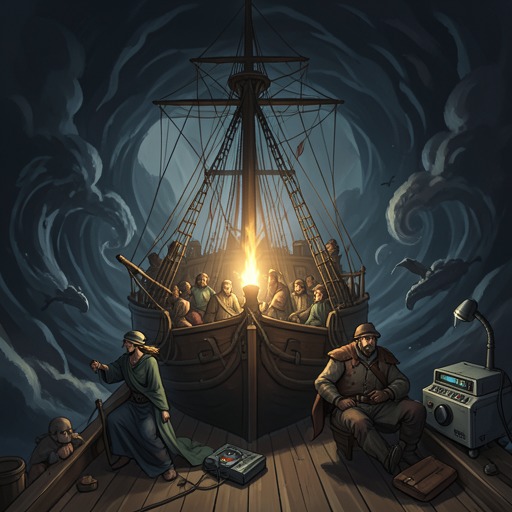
The Empress first seeks the Immaterial Spirits because she wants news of the world she left behind and has no other way to discover its condition. The Worm-men report no spirits within the Earth, where they find only embodied, material creatures. The Fly-men, whose numerous eyes make them especially suited to observing the air, say that spirits lodge in its vehicles. These beings are not seen without some material covering: their bodies are usually made of air, though they can assume other substances, but cannot shape those substances into any form they please. The Empress asks the Fly-men to invite them to visit, and they do so.
The Spirits’ own account makes the vehicle more than a disguise. They say that they cannot move by themselves: incorporeal beings receive motion from corporeal vehicles, and the purer, rarer, and lighter kinds of matter enable faster movement. They cannot speak or exercise bodily senses without bodies, though they claim a supernatural kind of knowledge unavailable through natural sense. Created spirits, they add, lack general or absolute knowledge; only God possesses perfect knowledge of all things. Their vehicles are self-moving bodies and therefore living, while the Spirits cannot leave them. Vehicles may change into different forms and figures, but the Spirits’ dependence on them unsettles any simple division between an active spirit and passive matter.
This account meets the Empress’s own natural philosophy, in which Nature is one infinite self-moving body, divided into parts that continually compose, divide, and change. In her discussion with the Ape-men, she rejects the search for primary ingredients through chemical experiments: fire produces different effects in different bodies and cannot disclose a single set of universal principles. She argues instead for self-moving matter as the universal principle of natural effects. The Spirits’ insistence that natural bodies give them motion brings their supposed incorporeality into contact with this materialist account, without making their testimony identical to the Empress’s position.
Testimony, Memory, and the Limits of Knowledge
The Spirits inform the Empress about her homeland and acquaintances, and give her accounts of celebrated students, writers, and experimental philosophers. Her questions turn from reported facts to the conditions of knowledge itself. When she asks about Ben Jonson’s play The Alchymist, the Spirits explain the identities behind its characters, but cannot remember whom the Druggist represented. They say that what has passed remains in memory only if it has been recorded. The Empress objects that spirits ought not to be subject to forgetfulness; they answer that knowledge of present things is not the same as remembering past ones, and that their foresight comes from observing and comparing past and present actions. Their supernatural status therefore does not free them from the ordinary problems of memory and evidence.
Their account of the Cabbala likewise denies them authority to settle every question they discuss. They describe competing understandings of the Cabbala as traditional, scriptural, literal, or metaphorical, and say that writers may claim divine inspiration, though the Spirits cannot judge whether such claims are true. They distinguish theological Cabbala, which belongs to faith, from natural Cabbala, which belongs to reason. They also tell the Empress that natural reason is not divine faith, that created beings cannot know God absolutely, and that no creature possesses complete knowledge. Their answers repeatedly draw a boundary between inquiry that reason can pursue and divine matters beyond their competence.
The Empress presses them on motion, souls, evil, and the relation of life to matter. They say that natural lives, forms, and matter are inseparable, and describe Nature as a living, self-knowing body whose inanimate, sensitive, and rational degrees are intermingled. They deny that spirits give motion to natural bodies, and argue that immaterial souls cannot occupy one inanimate body in plurality because they have neither parts nor place; a composed body, by contrast, may contain numerous material souls. They also say that a world belongs to material creatures rather than immaterial ones, while no world of matter can exist without lives and forms. These explanations make the Spirits participants in the book’s philosophical disputes, not detached arbiters who resolve them.
Disappearance and the Proposed Cabbala
When the Empress says she wants to make a Jewish Cabbala, the Spirits immediately disappear. The sudden departure leaves her in a trance; on recovering, she becomes melancholy and supposes that her questions may have caused the Spirits to be condemned to the lowest and darkest vehicles. She sends for the Fly-men and Worm-men and explains that she is distressed not merely by the Spirits’ absence, but by the possibility that she has brought harm upon them. The Worm-men reassure her that life within the Earth need not be miserable: it is warm, fruitful, quiet, and safe, and its inhabitants have light by which to see.
The Empress nevertheless wants to know what happened. The Worm-men descend through the Earth, while the Fly-men travel through the air. The Worm-men learn at the Earth’s centre that the Spirits have gone to the Antipodes. The Fly-men, who have rounded the globe, confirm that they found them there in good condition. The Spirits explain that their vehicles carry their own light, like cats’ eyes, glow-worms’ tails, and rotten wood, so they do not fear darkness. They also say that they remain willing to help with the Cabbala. Relieved, the Empress rewards both groups of messengers.
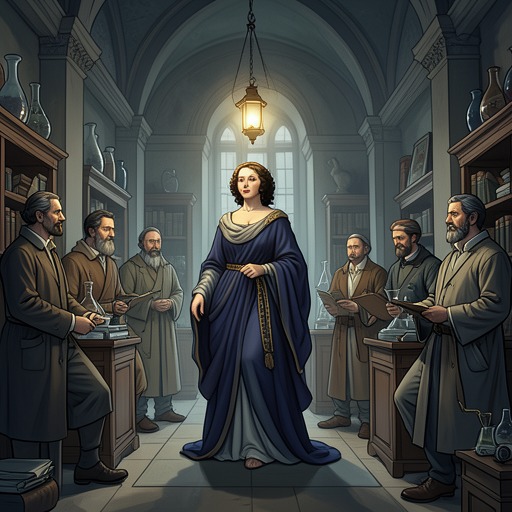
The Spirits then offer a scribe for the proposed work. They can dictate but cannot write unless they put on a hand or arm, or an entire human body. When the Empress asks whether they can take the soul of a living person, they invoke the doctrine that the souls of lovers live in the bodies of their beloved. She considers ancient and modern writers, but the Spirits say that the famous men she names are too attached to their own opinions or too self-conceited to serve as scribes. Instead they recommend the Duchess of Newcastle as a plain, rational writer whose work is grounded in sense and reason. The Empress chooses the Duchess’s soul, partly noting that the Emperor need not be jealous of a spiritual beloved of her own sex.
The Spirits’ recommendation brings the Duchess into the Empress’s intellectual and personal world, but it does not give the Empress the authority she hopes to obtain. The Duchess warns that the Spirits are ignorant in many matters and have no general or absolute knowledge; they cannot know human thoughts or the Creator’s mysteries unless divine knowledge is granted to them. She advises against making a Cabbala, whether scriptural, philosophical, moral, or political, and proposes a poetic or romantic alternative if the Empress insists on creating one. The episode thus turns the Spirits’ service into a test of their limits: they can summon and advise, but cannot guarantee the truth of the undertaking.
Friendship, Counsel, and Narrative Role
The Spirits also help bring the Duchess’s soul into contact with the Empress when the Duchess longs to become Empress of a world. Asked whether there are other worlds she might rule, they say that worlds are numerous, even infinite, but all are inhabited and governed. They warn that conquerors are often feared rather than loved and may come to untimely ends. Instead of directing the Duchess toward a material conquest, they propose that each human creature can create an immaterial world within the head or skull, populate it with immaterial subjects, and give it whatever forms, motions, perceptions, and government the creator chooses. The Duchess’s ambition is thereby redirected from acquiring sovereignty over an external world toward imaginative world-making.
Later, as the Duchess prepares to return to her own world, the Spirits promise to try to make peace between Fortune and the Duke of Newcastle. Their role in that dispute is a further offer of mediation, though the account does not establish that they succeed. In another passage, they visit the Empress and provide intelligence about the war threatening her native country, information that leads her to grieve and prompts the Emperor to offer assistance. Their access to distant events gives them an important place in the narrative’s movement between worlds, but their own explanations insist that their knowledge is partial and dependent on what they can observe or remember.
The Immaterial Spirits therefore occupy a productive contradiction. They cross distances, disclose information, and help join characters and worlds, yet they remain dependent on bodies, limited in memory, and unable to claim universal knowledge. Their testimony enables the Empress to act and to question, while the Duchess’s cautions prevent supernatural access from being mistaken for certainty. Through that tension, the Spirits connect the story’s imaginative cosmology to its recurring scrutiny of matter, reason, faith, and the limits of created minds.